In industries with strict requirements for Purified Water or Water for Injection (WFI), such as pharmaceuticals, healthcare, food processing, and life sciences, the choice of water distillation system is not merely a technical decision—it’s a strategic one. Single-effect and multi-effect water distillers are the two dominant solutions in the field, but the difference between them goes far beyond “number of stages.”
In this article, we’ll provide an in-depth comparison from a process engineering perspective, covering how these systems operate, their impact on energy efficiency, regulatory compliance, and how they perform in high-demand environments.
A single-effect water distiller operates with just one evaporation-condensation unit. Feedwater is heated (usually by steam or electricity) to generate vapor, which is then condensed into distilled water. The energy used in heating is not reused, and the system relies entirely on a single energy input.
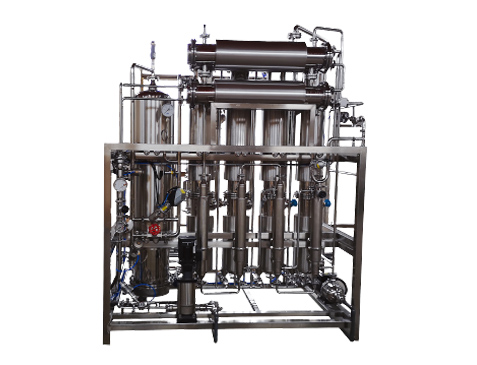
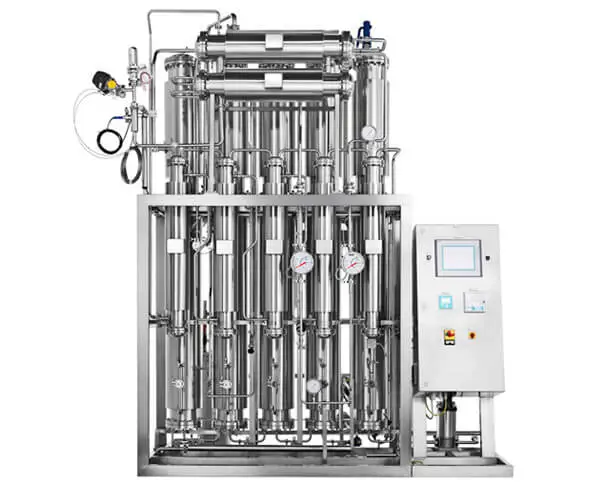
A multi-effect water distiller, on the other hand, utilizes a chain of evaporators. Each subsequent stage uses the steam from the previous stage as its heating source. This “cascade effect” recycles thermal energy across multiple stages, dramatically improving energy efficiency while reducing steam consumption.
This cascading design is a key reason why multi-effect systems are now widely adopted in energy-conscious and GMP-compliant pharmaceutical facilities.
Below is a practical comparison based on Biocell’s internal performance data and widely observed industry benchmarks:
| Feature | Single-Effect Distiller | Multi-Effect Distiller (e.g., 6-effect) |
|---|---|---|
| Steam Consumption (kg steam/kg water) | ~1.1 – 1.2 | ~0.18 – 0.25 |
| Cooling Water Demand | High | Significantly lower (due to heat reuse) |
| Startup Time | Faster | Slightly slower (more complex system) |
| Control System | Basic PLC or semi-automatic | Fully automated PLC + HMI, GMP ready |
| Water Output Quality | Purified water (some systems reach WFI) | Consistently meets EP/USP WFI standards |
| Initial Investment | Lower | Higher (varies by number of effects & control) |
| Application Scope | Small/medium scale | Medium to large-scale industrial applications |
| Compliance Level | For basic needs | Ideal for full cGMP/validation environments |
If your facility produces injection-grade products, ophthalmics, dialysis solutions, or other water-critical formulations, selecting a multi-effect distiller isn’t just about energy—it’s about staying compliant.
Global pharmacopeias define acceptable WFI production methods:
USP & EP: Allow either multi-effect distillation or membrane-based systems + final heat sterilization
China Pharmacopoeia (2020): Only accepts distillation-based WFI production (multi-effect or vapor compression)
Given this regulatory context, multi-effect systems capable of delivering endotoxin-free WFI under continuous, validated operation are essential for pharmaceutical manufacturers aiming for long-term regulatory approval.
In large-scale operations, such as 24/7 injection manufacturing or cephalosporin production, energy consumption can account for up to 30% of water system OPEX.
For instance, in a Biocell 6-effect WFI system project producing 150 tons/year, switching from single-effect to multi-effect saved over $35,000 USD in steam costs over 3 years—without compromising output or quality.
Thus, the multi-effect system is not just an “upgrade”; it’s an investment in operational resilience and energy optimization.
With years of experience delivering validated water systems across pharma, biotech, and healthcare, Biocell’s multi-effect water distillers stand out not just for performance—but for process integrity.
Our solutions include:
Modular design for easy expansion and maintenance
Premium 316L stainless steel and full orbital welding
Optional Pure Steam outlet for dual-function units
Integrated validation package with IQ/OQ documentation
Full compliance with EU-GMP, FDA 21CFR PART 11, and global pharmacopeia standards
We serve clients across sectors:
Pharmaceuticals
Hospitals and laboratories
Food & beverage plants
Medical device factories
Water treatment system integrators
In today’s climate of rising energy costs and regulatory tightening, single-effect distillers may still hold value for basic or low-throughput needs. But for forward-looking manufacturers, especially those requiring continuous high-purity water production under strict regulatory scrutiny, the multi-effect system is the clear choice.
A multi-effect distillation unit is not merely a piece of equipment—it is a critical asset for ensuring quality, compliance, and cost-efficiency in modern production facilities.
This is the first one.
 English
 日本語
日本語 한국어
한국어 français
 Svenska
 Türkçe
 Malay
Malay Deutsch
 русский