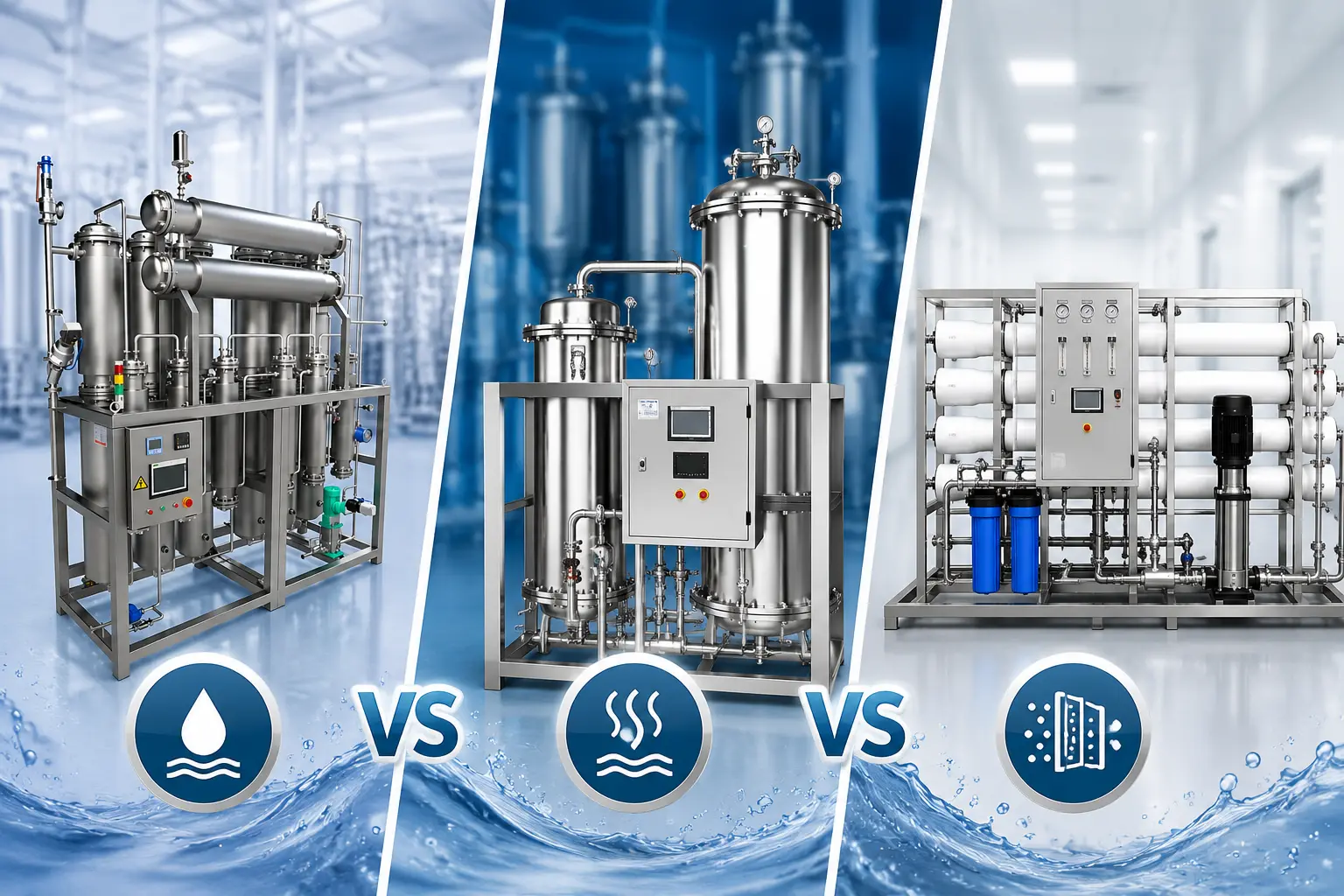
Water for Injection (WFI) is the highest purity grade of bulk water used in pharmaceutical manufacturing, and every injectable drug product depends on a reliable supply. The question of how to produce it — multi-effect distillation, vapor compression distillation, or membrane-based methods — is one of the most consequential equipment decisions a pharmaceutical facility will make. The wrong choice can mean hundreds of thousands of dollars in excess operating costs, unnecessary complexity, or — worse — a system that cannot reliably meet pharmacopoeia specifications under real-world conditions.
This article provides a technical and economic comparison of the three WFI production methods so you can make an informed specification decision.
| Factor | Multi-Effect Distillation (MED) | Vapor Compression (VC) | Membrane-Based |
|---|---|---|---|
| Core principle | Sequential distillation columns using steam to produce purer steam | Mechanical compression of vapor to recover latent heat | Reverse osmosis + electrodeionization + ultrafiltration |
| Energy consumption | High (steam-driven) | Moderate (electricity-driven compressor) | Low (pump pressure only) |
| Feed water requirement | Purified Water (PW) | Purified Water (PW) | Drinking water (with pre-treatment) |
| WFI output temperature | Hot (80–99°C) | Hot (80–99°C) | Ambient (can be heated post-treatment) |
| Pharmacopoeia compliance | USP, EP, JP (universally accepted) | USP, EP, JP (universally accepted) | USP (accepted for decades); EP (accepted since 2017) |
| Typical capacity range | 50–10,000+ L/h | 50–5,000+ L/h | 100–10,000+ L/h |
| Capital cost | Moderate to high | Moderate | Moderate |
| Operating cost (energy) | Highest of the three | Moderate | Lowest |
| Maintenance complexity | Moderate (descaling, gasket replacement) | Moderate (compressor maintenance) | Higher (membrane replacement, UF integrity testing) |
| Microbial assurance | Highest (thermal kill step) | Highest (thermal kill step) | High (UF barrier, but no thermal kill) |
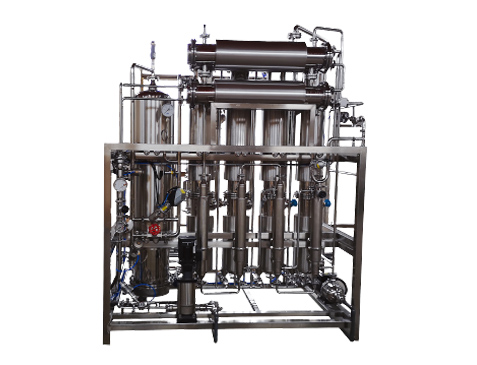
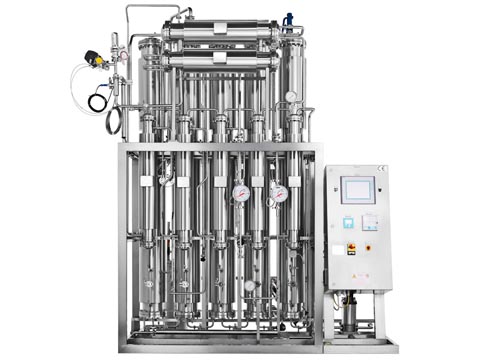
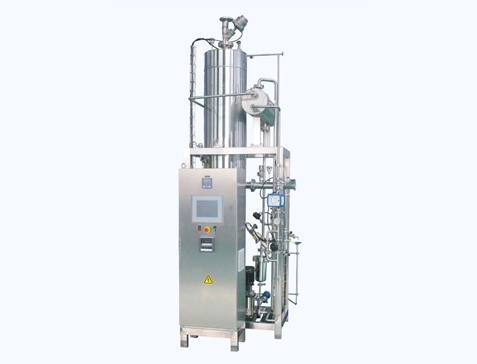
A multi-effect distillation wfi generator uses a series of distillation columns (effects) arranged in sequence. Plant steam heats the first column (first effect), evaporating PW feed water into pure vapor. This vapor then serves as the heating medium for the second effect, and so on. Each successive effect operates at a lower pressure and temperature, allowing the latent heat from the previous effect to drive evaporation.
A 5-effect distillation unit can produce approximately 4–5 kg of WFI for every 1 kg of plant steam consumed. More effects mean better energy efficiency but higher capital cost.
Universally accepted: No regulatory jurisdiction disputes thermal distillation as a valid WFI production method
High throughput: Scales well for large-volume facilities (5,000–10,000+ L/h)
Robust thermal kill step: Every drop of WFI has been boiled, providing maximum microbial assurance
Hot WFI output: Produces WFI at 80–99°C, ready for hot distribution loops — no additional heating required
High energy consumption: Requires significant plant steam, especially in smaller units where the steam-to-WFI ratio is less favorable
Cooling water demand: Condenses vapor in the final effect, requiring cooling water
Sensitive to feed water quality: Scaling in the columns increases with poor feed water quality, requiring periodic descaling
MED is the established choice for large-scale pharmaceutical manufacturing where hot WFI distribution is the standard and plant steam is readily available. Facilities producing >2,000 L/h of WFI typically find MED the most cost-effective thermal option.
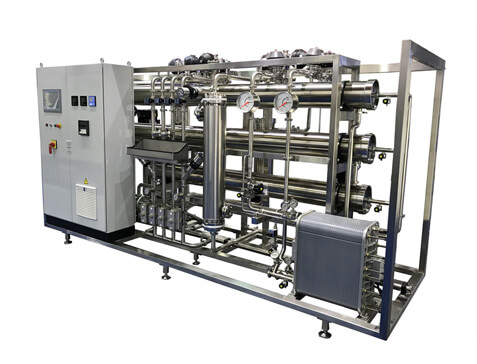
A vapor compression wfi generation system also uses distillation — but instead of using external plant steam to drive each effect, it uses a mechanical compressor to compress the vapor produced during evaporation. Compressing the vapor raises its temperature and pressure, allowing it to serve as the heating medium for the evaporator. The system essentially recycles its own latent heat.
The primary energy input is electricity to run the compressor, not plant steam. This makes VC more energy-efficient than MED, particularly at smaller capacities.
Lower energy consumption than MED: Compressor-driven heat recovery uses less energy per liter of WFI produced
No cooling water required: The compressed vapor condenses within the system, eliminating the need for external cooling
Compact footprint: Fewer effects means a smaller physical installation compared to high-effect MED units
Thermal kill step maintained: Like MED, VC produces WFI through distillation, providing the same microbial assurance
Compressor maintenance: The mechanical compressor is the critical moving part — bearings, seals, and motor require periodic maintenance and eventual replacement
Scale sensitivity: More sensitive to scaling than MED due to the evaporator design; feed water quality must be tightly controlled
Capacity limitations: Less commonly available in very large capacities (>5,000 L/h) compared to MED
VC distillation excels in mid-range facilities (200–3,000 L/h) where energy costs are a priority, cooling water is limited, or the facility does not have abundant plant steam. It is widely used in standalone WFI generation systems where operational cost matters more than maximum throughput.
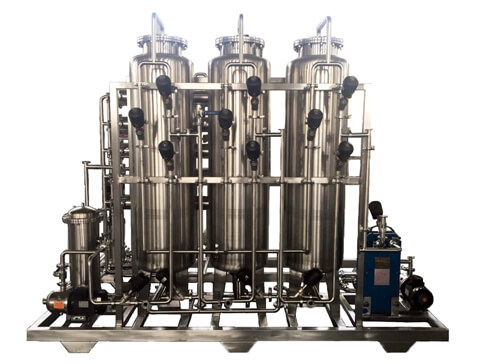
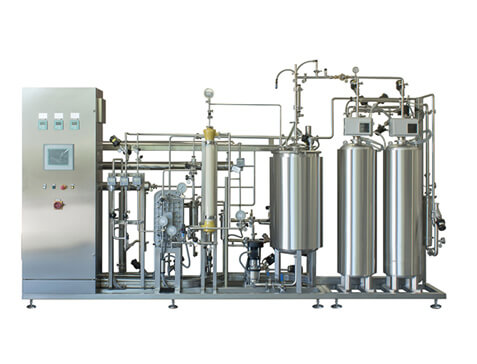
Membrane-based water for injection generation systems produce WFI without thermal distillation. A typical membrane-based water for injection plant includes:
Pre-treatment: Multimedia filtration, softening, and activated carbon to remove particulates, hardness, and chlorine from the feed water (which can be potable water, not necessarily PW)
Reverse Osmosis (RO): Two-pass RO removes >99% of dissolved ions, organic molecules, and particles
Electrodeionization (EDI): Polishes the RO permeate to near-WFI conductivity levels
Ultrafiltration (UF): A final membrane barrier that removes endotoxins and any remaining particles or microorganisms
The EP monograph for WFI was revised in 2017 to formally allow membrane-based production, provided the system is qualified to consistently meet WFI specifications. USP has accepted membrane-based WFI for decades.
Lowest energy consumption: No boiling — only pump pressure drives the process
Ambient temperature production: No heat energy needed; WFI is produced at room temperature
No cooling water required: No condensation step
Simpler maintenance (no thermal components): No boilers, evaporators, or compressors to maintain
Lower carbon footprint: Significantly reduced energy usage compared to thermal methods
No thermal kill step: Microbial control relies entirely on the UF membrane barrier and system design — there is no boiling process to guarantee sterilization
Membrane replacement costs: RO and UF membranes have finite lifespans (2–5 years depending on feed water quality and loading) and represent a significant recurring cost
UF integrity testing required: The UF module must be integrity-tested regularly (typically daily before use) to confirm the endotoxin removal barrier is intact
Regulatory scrutiny: While pharmacopoeia-accepted, membrane-based WFI systems may receive closer inspection attention from auditors unfamiliar with the technology
Not universally preferred: Some companies and regulatory jurisdictions still favor thermal methods for critical applications
Membrane-based systems are ideal for facilities seeking lower operating costs, reduced energy consumption, or ambient WFI distribution. They are increasingly popular in biopharma facilities where WFI is used for non-parenteral applications, equipment rinsing, and as feed water for further processing. A well-designed membrane-based water for injection machine with proper UF integrity testing and robust SOPs can reliably produce WFI that meets all pharmacopoeia requirements.
| Cost Factor | MED | VC | Membrane |
|---|---|---|---|
| Primary energy source | Plant steam + electricity | Electricity (compressor) | Electricity (pumps only) |
| Energy per 1,000 L WFI (approx.) | 350–500 kg steam | 30–60 kWh | 10–25 kWh |
| Cooling water | Required | Not required | Not required |
| Estimated annual energy cost (2,000 L/h, 8,000 h/yr) | $120,000–200,000 | $40,000–80,000 | $15,000–40,000 |
Membrane-based systems have a clear energy cost advantage. For facilities where sustainability targets or energy costs are primary drivers, the membrane approach can save50,000–150,000+ per year in operating costs compared to MED.
| Risk Factor | MED | VC | Membrane |
|---|---|---|---|
| Thermal kill step | Yes (boiling) | Yes (boiling) | No |
| Endotoxin removal mechanism | Distillation (phase change) | Distillation (phase change) | UF membrane barrier |
| Microbial regrowth risk during downtime | Low (hot system) | Low (hot system) | Higher (ambient system — requires sanitization protocol) |
| Regulatory comfort level | Highest | High | Growing acceptance |
Thermal methods provide inherent microbial assurance that membrane systems cannot fully replicate. This does not mean membrane systems are inferior — it means they require more rigorous operational controls (sanitization schedules, UF integrity testing, biofilm prevention) to achieve equivalent assurance.
| Capacity | MED | VC | Membrane |
|---|---|---|---|
| < 500 L/h | Less common (high cost per liter) | Available and efficient | Available and efficient |
| 500–2,000 L/h | Competitive | Most competitive | Competitive |
| 2,000–5,000 L/h | Strong offering | Available | Strong offering |
| > 5,000 L/h | Strongest offering | Limited options | Available |
For very large-volume production, MED remains the industry standard. For mid-range and smaller volumes, both VC and membrane systems offer compelling advantages.
| Maintenance Item | MED | VC | Membrane |
|---|---|---|---|
| Descaling frequency | Every 6–12 months | Every 6–12 months | N/A (no evaporator) |
| Compressor overhaul | N/A | Every 3–5 years | N/A |
| RO membrane replacement | N/A | N/A | Every 2–4 years |
| UF membrane replacement | N/A | N/A | Every 2–5 years |
| EDI module replacement | N/A | N/A | Every 3–5 years |
| Gasket/seal replacement | Annually | Annually | Annually |
| Annual maintenance cost estimate | $15,000–30,000 | 20,000–40,000 (incl. compressor) | $25,000–50,000 (incl. membranes) |
There is no single correct answer — the optimal choice depends on your facility's specific circumstances.
Your facility produces >2,000 L/h of WFI
Hot WFI distribution is your standard (most existing facilities)
Plant steam is abundant and inexpensive at your site
Your quality team or regulatory jurisdiction strongly prefers thermal methods
You need the highest possible microbial assurance with minimal operational complexity
Your WFI demand is 200–3,000 L/h
Energy costs are a significant concern
Cooling water is limited or expensive
You want thermal WFI production with lower operating costs than MED
Your facility does not have abundant plant steam
Energy costs and sustainability targets are primary drivers
Ambient WFI distribution is acceptable for your applications
Your facility is open to a modern, non-thermal approach
You have robust SOPs for UF integrity testing and system sanitization
You want the lowest total operating cost over a 10+ year lifecycle
USP has accepted membrane-based WFI for decades. EP accepted it in 2017 when the European Pharmacopoeia monograph was revised. JP also recognizes membrane-based production. However, some individual companies and certain regulatory inspectors may still favor thermal methods, so it is advisable to discuss your approach with your regulatory affairs team.
Yes, but it is a significant change that requires thorough risk assessment, change control, and revalidation. The distribution system may need modification (particularly if moving from hot to ambient WFI). A phased approach — running both systems in parallel during qualification — reduces risk.
For a 2,000 L/h system, membrane-based WFI typically achieves full ROI on the energy savings alone within 3–5 years compared to MED. However, the total cost of ownership calculation must include membrane replacement costs, UF integrity testing labor, and any additional validation complexity.
No. Membrane systems can accept potable (drinking) water as feed, with appropriate pre-treatment (softening, carbon filtration, etc.). This is an advantage over distillation-based systems, which typically require pre-purified PW feed water. However, the pre-treatment chain for a membrane system must be robust and well-maintained.
A water for injection machine typically refers to the generation unit alone, while a complete system includes pre-treatment, storage, distribution, and controls. For greenfield facilities, a complete integrated system is usually more cost-effective and simpler to validate. For brownfield sites adding WFI capacity, a standalone generator may integrate more easily with existing infrastructure.
Selecting the right WFI production technology requires balancing energy costs, microbial assurance, regulatory expectations, and long-term operational considerations. Whether your priority is the proven thermal assurance of distillation or the energy efficiency of membrane-based production, working with an experienced equipment partner ensures your system is correctly specified and qualified from day one.
Contact a WFI system specialist to discuss your production requirements, request a detailed proposal, or schedule a technical evaluation for your facility.
 English
 日本語
日本語 한국어
한국어 français
 Svenska
 Türkçe
 Malay
Malay Deutsch
 русский